

Why most posts fail from the bottom up under your deck
Let’s talk honestly about timber posts in the ground
If you have been around decks for any length of time, you will already know why most posts fail. It is almost always right at ground level. That should tell us something. Timber does not fail because it is weak. It fails because ground contact creates the perfect conditions for decay. Therefore, when we design decks, we need to think less about timber strength and more about how timber lives and dries
“Why most posts fail” is quite a common question from clients directed to the Decking Network”
UC3 and UC4 explained without the sales pitch
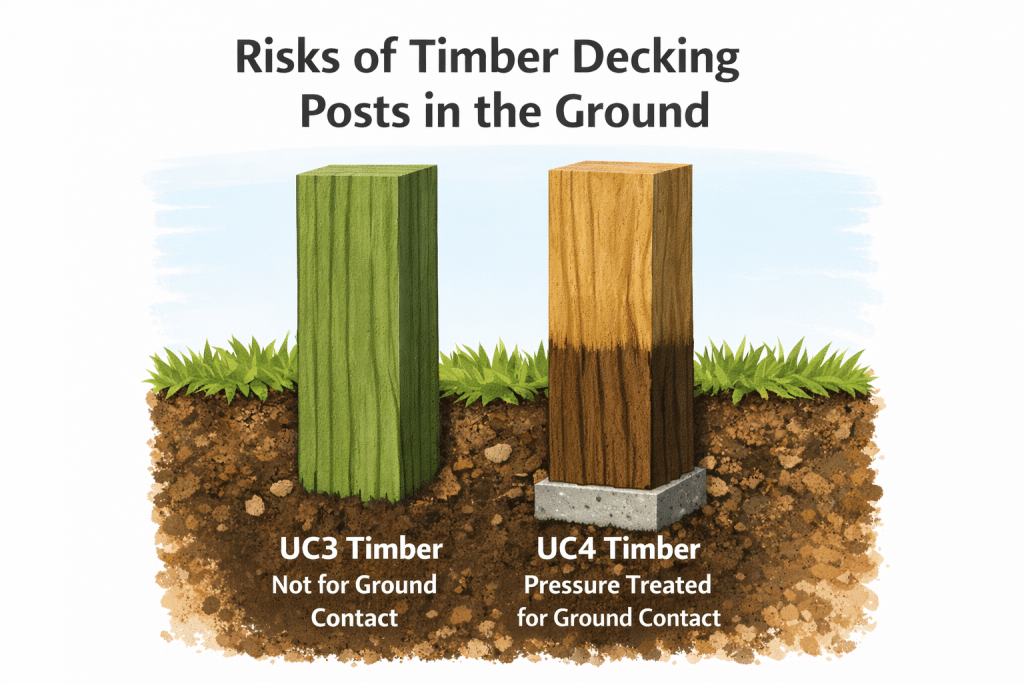
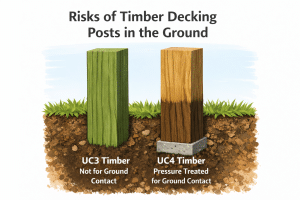
We often hear UC3 and UC4 mentioned as if they are magic labels. They are not. UC3 timber is intended for above-ground use where air can circulate freely. Because of that, UC3 should never be buried, regardless of coatings or clever ideas. UC4 timber is pressure treated for ground contact. However, that treatment slows decay rather than eliminating it. Over time, moisture still gets in, and decay still follows.
Why UC4 is durable but never permanent
Many homeowners assume UC4 means it will last forever. Installers sometimes imply the same. In reality, UC4 timber simply buys you more time. Preservatives penetrate the timber, yet moisture still enters through end grain and natural movement. As a result, decay almost always develops at the ground line. So, UC4 should be treated as a managed risk, not a guarantee.
Post sleeves sound clever but behave badly
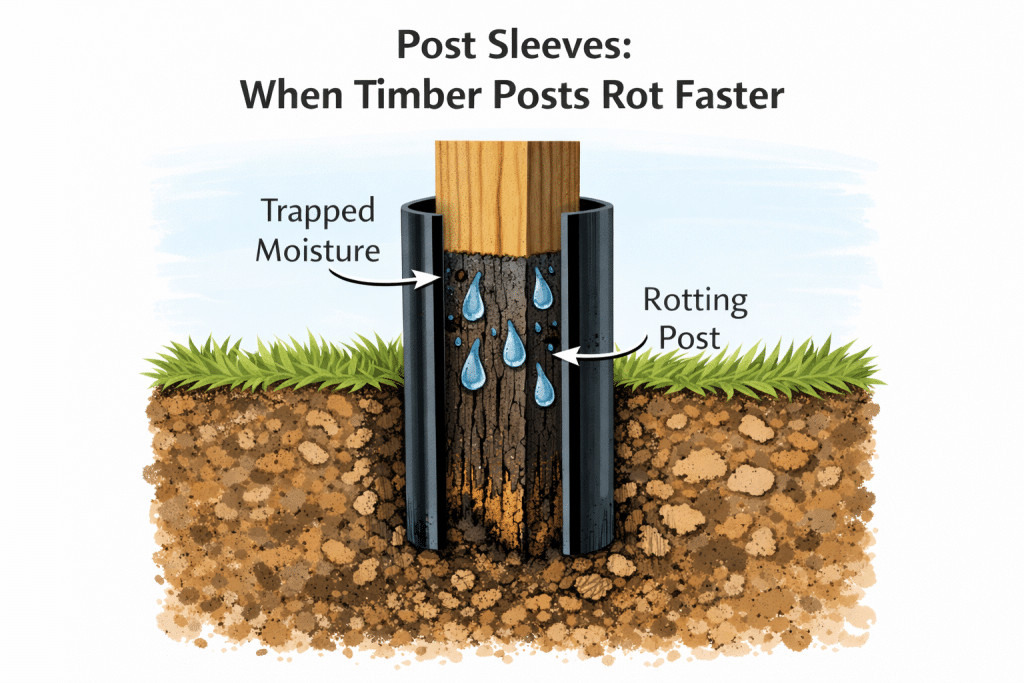
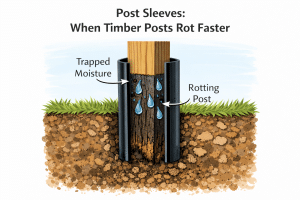
Post sleeves often look like a smart upgrade. The idea sounds logical. Isolate the timber from the soil and you stop rot. In practice, the opposite often happens. Water finds its way inside the sleeve and then struggles to escape. Consequently, the post stays damp for long periods. Over time, that trapped moisture accelerates decay instead of preventing it. Why most posts fail, well they do with post sleeves.
Bitumastic paint feels reassuring but rarely delivers
Bitumastic coatings and thick paints promise waterproof protection. On paper, that sounds ideal. However, timber moves constantly as moisture levels change. Eventually, coatings crack. Once cracked, water enters behind the coating and becomes trapped. As a result, decay progresses internally while the outside looks fine. From experience, this failure often comes as a surprise.
Charring timber and where tradition meets reality
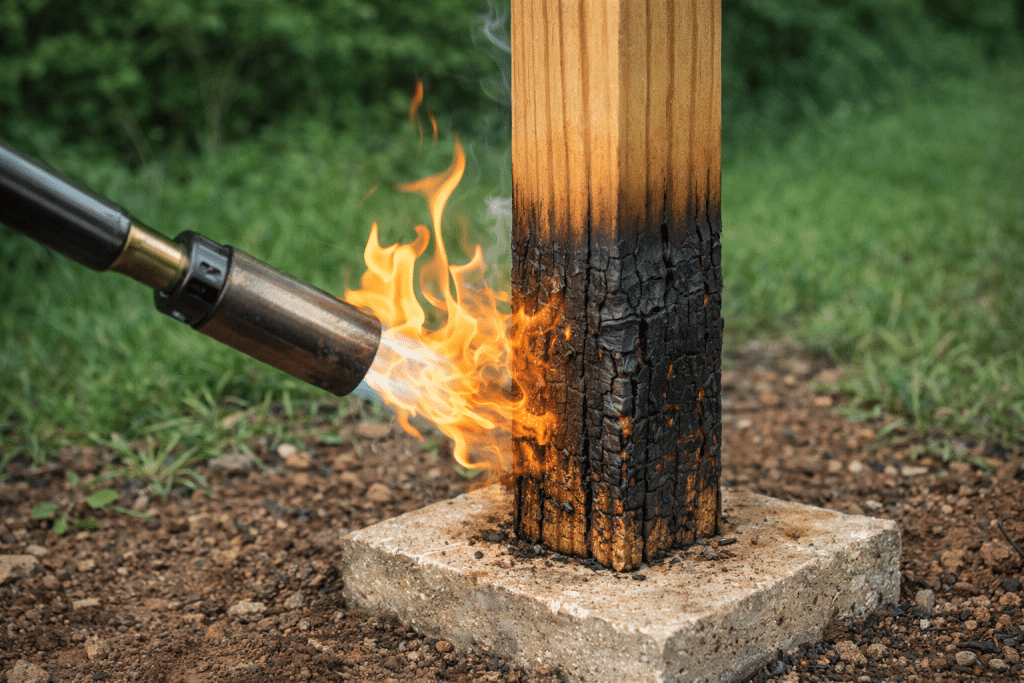
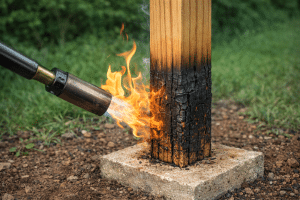
Charring timber has history behind it, and that history deserves respect. Archaeology shows charred timber can outlast untreated wood. However, traditional charring involved controlled processes and large sections. On modern sites, torch charring tends to be shallow and inconsistent. More importantly, cracking allows moisture straight into the most vulnerable zone. Therefore, charring cannot offer predictable durability for buried structural posts.
Why installers should think beyond technique
This is where liability quietly enters the conversation. Non-standard durability methods lack recognised benchmarks. When a post eventually rots, the discussion rarely focuses on biology or chemistry. Instead, it focuses on who installed it last. Clear, defensible construction methods protect installers just as much as clients. Hope-based detailing rarely survives a dispute.
The simplest answer is usually the best one
If timber stays dry, it lasts longer. That principle never changes. Keeping posts out of the ground removes the most aggressive decay mechanism entirely. Instead of fighting moisture, you avoid it. As a result, service life improves dramatically, and inspection becomes straightforward. This is why experienced installers increasingly avoid burying timber altogether.
Concrete pads and proper post supports
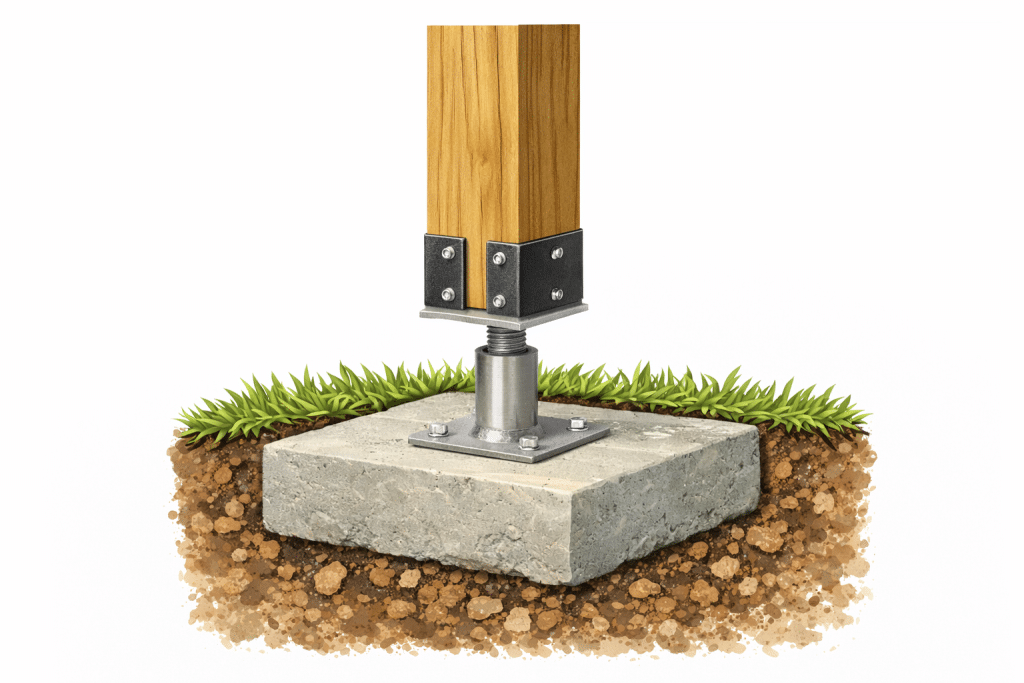
A well-detailed solution uses a concrete pad that projects above ground. A metal post support fixes into or onto that pad. The timber never sits in soil or standing water. Consequently, it dries naturally after rain. Just as importantly, if a post ever needs replacing, you can do so without digging out foundations. FH Brundle have a selection. of post supports Adjustable post supports are always in stock here
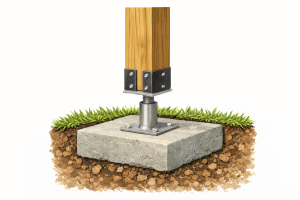
Using UC4 properly rather than relying on it
UC4 timber still has a place. When combined with post supports, it performs far better than when buried. Moisture exposure reduces while preservative protection continues to work. Therefore, UC4 does what it was designed to do rather than compensating for poor detailing. This approach balances cost, performance, and longevity.
Looking beyond timber when appropriate
Some projects justify different materials. Recycled HDPE posts remove decay from the equation entirely. Steel posts, whether PFC or RSJ, offer predictable structural performance when set to the correct depth. As always, detailing matters, particularly corrosion protection. Even so, these options eliminate biological failure, which is often the biggest unknown.
Helping clients make better long-term decisions
Good detailing helps everyone. Homeowners gain confidence and reduced maintenance. Installers gain clarity and reduced risk. In-ground timber posts remain common, but that does not make them the best choice. By keeping timber out of the soil, you choose predictability over optimism. And in decking, predictability always wins
Why most posts fail