


Smooth Decking vs Grooved Decking
What’s the best decking surface
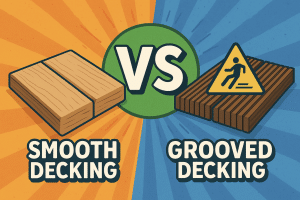
Smooth decking vs grooved decking is “The” most common question when choosing the right deck surface for your garden. Grooved, ribbed or smooth decking? All styles have their champions, but they serve very different purposes.
Let’s explore the differences, advantages, and drawbacks. We’ll look at slip resistance, aesthetics, maintenance, installation, and compliance with British Standards.
Clean Lines vs Traditional Look
Smooth decking gives a sleek, modern finish. It creates a clean visual flow and highlights the grain of the timber or composite. For minimalist or contemporary gardens, it’s often the go-to choice.
Grooved decking offers a more traditional appearance. The texture adds visual detail, which some homeowners prefer, especially for rustic or cottage-style settings.
However, grooved boards can feel visually busy in smaller gardens, tough on bare feet too. Smooth boards reflect light better and make spaces feel more open.
Winner for modern design is Smooth decking
What decking is easier to clean? Smooth decking wins hands down when it comes to cleaning and upkeep.
“Why?” Well, the grooves collect dirt, leaves, moss, and algae. Cleaning between them requires pressure washing and even hand-scrubbing. Over time, this wears the surface and encourages water retention.
Smooth boards are far easier to sweep and mop. There’s nowhere for grime and muck to hide. That means less time maintaining your deck and more time enjoying it.
Slip Resistance – which Is safer?
Many assume that grooved decking is safer. But that’s a myth — or at least a misunderstood one. By reducing the contact surface area by as much as 50 to 60% you natural reduce the friction and thus creating an enhanced slippery surface.
Grooved decking was originally designed for commercial use. Its purpose was to allow surface water to run beneath the board, not off the top. In domestic settings, grooves often run the wrong way and actually trap water and algae, increasing slipperiness.
Smooth decking, when installed correctly, is no more slippery than grooved, it has more surface area and therefore more traction equals less slippery. In fact, BS EN 1176 and BS 7976-2 stress the importance of low slip risk in external surfaces — regardless of grooves.
For improved safety, consider anti-slip inserts or use high-friction composite decking with a smooth finish. Smooth, treated timber or composite boards often meet or exceed these standards when properly maintained.
Installation, which is easier?
Both types can be installed using standard methods, but smooth decking has fewer complications.
Grooved decking requires precise alignment. The grooves must face the right direction for water run-off. If there is no falls ratio along the board length it leads to water pooling, rot, and safety issues.
Smooth decking allows more flexibility. It’s easier to align and trim, and there’s less waste. Fixings are also simpler to hide on smooth surfaces, offering a clean, seamless look.
Composite smooth boards often come with hidden fixing systems, making installation fast and clean. Less so for pine boards, but most hardwoods and modified timbers such as Accoya work well as a smooth deck
Compliance and Standards
When it comes to decking installations in the UK, British Standards play a crucial role.
EN 1995 (Eurocode 5): Specifies design rules for timber structures, including decking frameworks.
BS 8579:2020: Provides guidance on balconies and terraces, where non-slip surfaces are critical.
BS 8417: Specifies durability and preservation of timber used outdoors.
These standards don’t require grooves — they require performance. That includes slip resistance, drainage, and longevity. Smooth boards can meet all of these with proper specification.
Weathering and longevity
Grooved decking often retains moisture. This speeds up decay in timber boards. In winter, trapped water in grooves can freeze and cause micro-cracks, leading to quicker degradation.
Smooth decking dries faster and encourages better air circulation. Especially in softwood or Accoya, smooth surfaces show fewer signs of weathering over time.
For capped composite decking, smooth boards tend to show fewer stains and scratches. They also feel more comfortable underfoot.
Hidden fixings and finishing touches
Grooved boards often require surface screws, which disrupt the look. Smooth decking supports hidden fixings, offering a high-end, seamless finish.
Hidden fixings
Reduce the risk of water ingress
Eliminate trip hazards
Look clean and professional
Timber decking leaders are Grad Systems UK with their innovative structure, and all of their wood decking offerings are smooth. They have Thermo pine and Ash, Kebony and Accoya with Bamboo being a very clever product.
Modern deck systems from brands like Millboard, Deckorators, and Trex are now favouring smooth finishes for these reasons.
Verdict, smooth decking leads the way
- Feature Smooth Decking Grooved Decking
- Aesthetics Sleek, modern Traditional look
- Maintenance Easy to clean Traps dirt and moss
- Slip resistance Equal or better Often misunderstood
- Installation Simpler layout Needs precise groove alignment
- Longevity Dries faster Holds moisture
- Hidden fixings Common Limited options
Smooth decking offers lower maintenance, more flexible installation, modern design compatibility and equal or better slip safety when installed correctly
Grooved decking offers much higher maintenance once, awkward installation, outdated design, its a diy product at best
Ribbed decking offers the most slippery surface there is, impossible to keep clean. It was a design invention for the agricultural requirements that didn’t work but some how caught on… its should stop!
Final Thoughts on smooth or grooved decking
Choosing the right decking is about more than looks. Think about how you’ll use the space, who will walk on it, and how much time you’re willing to spend on upkeep.
For a modern, clean, and durable decking solution, smooth boards are increasingly becoming the preferred choice for both timber and composite materials.
If you’re planning a new deck or replacing an old one, speak to a professional installer who understands British Standards and long-term performance. Don’t fall for the DIY groove myth — the best deck is the one that suits your style, safety, and lifestyle.
Written by: Karl Harrison
Professional Decking Designer & Member of the Decking Network