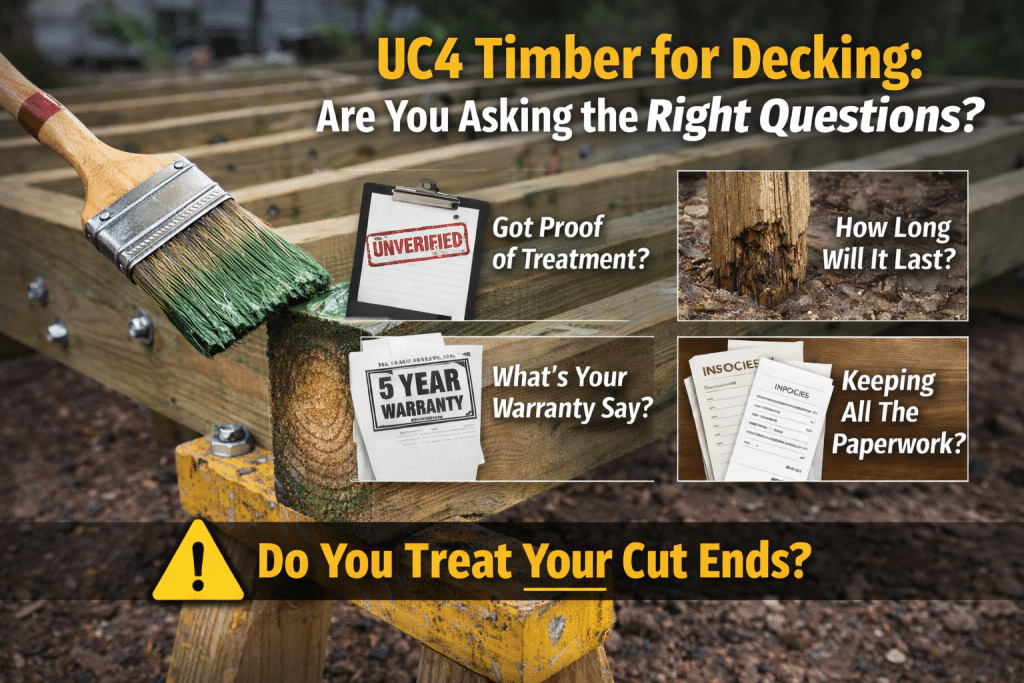


UC4 Timber for framing: Are You Asking the Right Questions?
What are you framing your deck with?
In decking, some phrases get used far too casually. “Pressure treated.” “Suitable for outside.” “UC4 timber for framing”, “It will be fine.”
Those words sound reassuring. However, they often hide a lack of detail. Many installers still buy structural timber on trust alone. That is where problems start.
When timber goes into a decking subframe, posts, or retaining work, the treatment standard matters. The timber species matters too. The expected lifespan matters as well. Yet many people still rely on a quick answer from the supplier and carry on regardless.
That approach is too loose for professional work.
Why UC4 should not be treated as a simple answer
Too many people hear the words UC4 and assume that settles the matter. It does not.
A treatment label on its own does not tell the full story. It does not explain how deeply the preservative has penetrated. The label doesn’t confirm how suitable the timber is for the exact job. It does not tell you what level of durability you should reasonably expect in service.
That is why installers need to dig deeper. If you are building a deck, the structure below the boards must cope with moisture, loading, and time. Broad reassurance from a merchant is not enough. You need clarity before you build, not excuses after something fails.
Why timber species matters
Species is not a minor detail. It has a direct effect on durability.
Different timbers accept treatment in different ways. Some species are easier to treat well. Others resist treatment more stubbornly. As a result, one piece of treated timber may not perform in the same way as another, even when both are sold under similar language.
That matters greatly in exposed external work. If the species is harder to treat, the risk increases. If the supplier stays vague and the installer never asks, the responsibility can drift straight onto the person fitting the deck.
Professional installers should know exactly what species they are buying.
Why lifespan needs a proper conversation
Many installers speak confidently about how long a timber subframe should last.
Far fewer define that expectation clearly before they place the order. That is a problem. If you talk about longevity, you should understand what standard of treatment sits behind that claim. You should also be comfortable backing that statement with paperwork and with your own written warranty. Otherwise, your confidence may be stronger than your evidence.
This is not about being negative. It is about tightening standards and protecting your business. make sure your paperwork says “UC4 Timber for framing and cites the correct Standard”
Why proof matters more than sales talk
When a dispute begins, verbal reassurance means very little.
The important questions become simple. What did you order?, what did the supplier deliver and what can you prove? That is why installers should ask for clear written confirmation of what they are buying. Invoices matter. Delivery notes matter. Product descriptions matter. Any written record that identifies the timber matters.
Without those records, you are relying on memory and assumption. That is a poor position to defend years later. UC4 Timber for framing must be documented
Why installers carry real risk
Some installers assume the supplier carries all the risk if the timber proves unsuitable.
That assumption is dangerous. If you chose it, bought it, fitted it, and then told the client it was suitable, you carry part of that responsibility. Long-standing trust in a merchant does not remove that risk. Habit does not remove it either.
Good installers do not rely on trust alone. They verify what they buy. That is not paranoia. It is sound commercial practice.
Questions every decking installer should ask
This is where the conversation needs to toughen up.
Ask the supplier exactly what they are supplying, what species the timber is and what treatment standard it meets. You must also ask what level of durability the supplier expects from it. Insist on written confirmation on the paperwork.
Then keep that paperwork. Also ask yourself a second set of questions. How long do you tell clients the structure should last? How long do you state in writing? Does your warranty reflect the evidence you hold? Could you defend that promise later if a client challenged it? Those are sensible questions, not awkward ones.
Why warranties need more discipline
Too many warranties are written too casually.
An installer may promise many years of service, yet that promise may rest on little more than habit and optimism. That is risky. A warranty should reflect the actual materials supplied, the environment they will face, and the confidence you can properly support.
If you promise too much and prove too little, you may create a problem that surfaces years later. That is why buying discipline matters so much at the start.
Why cut ends still expose poor habits
Small details often reveal the real standard of an installer.
Cut ends are one of those details. The moment you cut treated timber, you expose fresh timber fibres. If you ignore that exposed area, you weaken the protection at one of the most vulnerable points. Good installers understand this and act on it every time.
So ask yourself a blunt question. Do you treat your cut ends properly, every single time? Then ask a second question. What do you use to do it? That simple habit tells you a great deal about the discipline of a team on site.
Try Owatrol cut end treatment here and use code DECKINGNET10 for your discount…
Why record keeping protects installers
Professional installers need proper records.
Keep the invoices, the delivery notes and the supplier details. Keep anything that helps identify what materials went into a project. That paperwork protects you if a problem emerges later. It also helps you review which products and suppliers deserve your trust.
Many people only value records once a complaint lands on the desk. By then, it is too late to wish you had kept them.
The bigger question for the industry
The timber trade needs more honesty, and installers need to ask harder questions.
A treatment label should not end the conversation. It should start it. Installers need clarity before they build. Clients need honest answers about durability. Suppliers need to stand behind what they sell. Written proof should support every serious claim.
That is the standard the sector should aim for.
Final thoughts
A deck is only as dependable as the structure beneath it. Too many people buy treated timber on trust alone and assume the label answers everything. It does not. Better results come from better questions, better records, and better habits on site.
Ask for proof. Understand what you are buying. Be careful what you promise. Treat your cut ends properly. Keep your paperwork. Because when problems appear later, confidence does not protect you. Proof does
UC4 Timber for framing