

UK Decking Regulations: A Quick Update for Contractors and Homeowners
Questions to ask before you deck
As the decking season gets going again, it is worth revisiting a few of the rules that still catch people out. The same questions come up every year. Does it need planning permission? Does it need a balustrade? Can a homeowner sign that requirement away? Is the frame timber suitable? Are the screws actually right for structural work? Does my installer understand UK decking regulations?
These are sensible questions. However, they need answering before the deck is built, not after.
Planning permission should be checked first
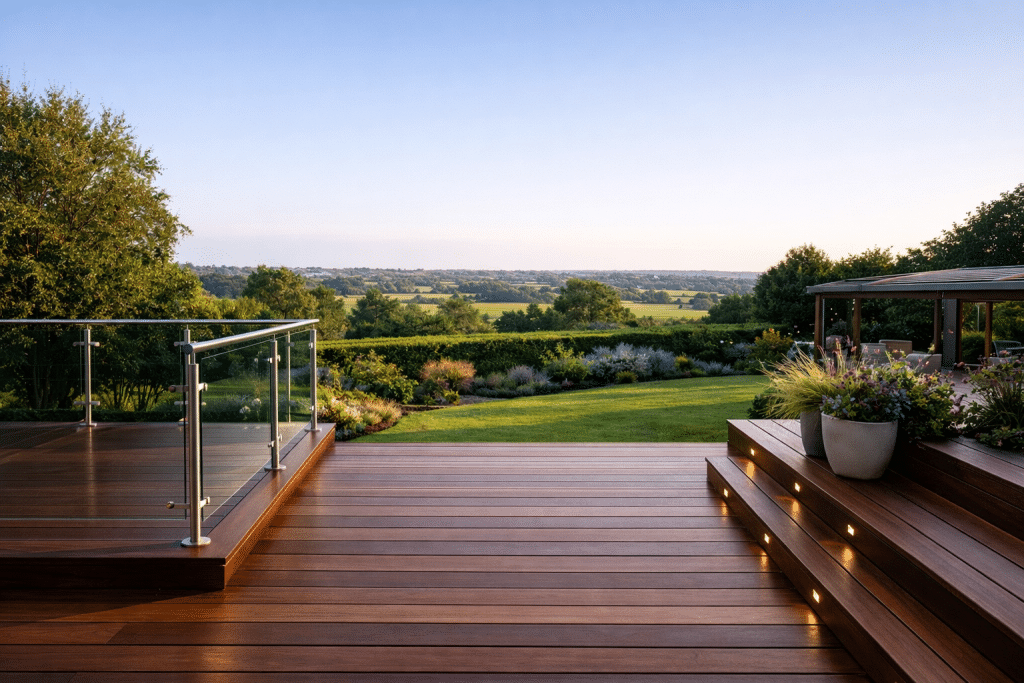
For a typical house in England, decking is often permitted development. Even so, there are some familiar limits that matter. The deck should usually be no more than 300mm above ground level. Together with other outbuildings and extensions, it should not cover more than 50 per cent of the garden. It should also not sit in front of the principal elevation of the house.
That sounds simple, but it is where people often come unstuck. Flats, listed buildings, conservation areas and local restrictions can all change the position. So, whether you are the contractor or the homeowner, you must check first rather than assume. You can read more about planning permission for your deck.
Raised decks need proper guarding
Once a deck becomes raised, the safety conversation changes. As a general guide, where there is a drop of more than 600mm, guarding becomes important. In many raised external situations, guarding is expected to be 1100mm high. Openings should also not allow a 100mm sphere to pass through.
This is not just a design choice. It is a safety issue and an important part of the UK decking regulations.
I still hear people say the client is happy without a balustrade and will sign something. That is not a proper answer and there is no such legal waiver for unsafe work. If somebody falls later, that decision will come under scrutiny very quickly.
If you are the contractor, you must not accept unsafe instructions and the homeowner, you must understand that safety cannot simply be signed away. You should start with ” do I need a decking balustrade ” and then look at the wider decking balustrade options.
The frame matters as much as the deck boards
A deck can look attractive on the surface and still be poorly built underneath. That is why the substructure matters so much. Posts, beams and joists are doing the real work. If they are not right, the quality of the whole project is already in doubt.
This is where treatment class, durability and proper structural thinking all come in. In simple terms, you must ask whether the deck is being built to last properly, or simply to look good at handover.
Homeowners should ask what is being used below the boards. Contractors should be ready to answer clearly. A good place to begin is this guide to decking substructure.
Structural fixings should never be guessed
Not every screw sold for outside use is suitable for structural decking work. That distinction matters far more than many people realise. Hidden deterioration in the frame can begin long before anything obvious appears on the surface.
That is why the fixings used in deck framing need proper thought. If you are building the structure, you must use fixings that suit the duty, the exposure and the lifespan expected of the deck. Details such as joist connection for deck framing deserve proper attention.
Good practice should stay under review
One of the easiest mistakes in decking is to rely on habit. Just because something was done on the last job does not mean it is the right detail for the next one. Good decking work should be based on proper judgment, sound structural thinking and current best practice.
That is why it helps to keep revisiting deck building guidelines, regulations and best practice as the market, products and expectations continue to develop.
Fire-risk settings are different again
A simple garden deck is one thing. Balconies and higher-risk residential settings are another. In those situations, fire performance becomes much more important, and the specification needs greater care.
This does not need overcomplicating for ordinary domestic decking. However, if you are asked to work on balconies or more sensitive residential projects, you must understand where the fire conversation changes and act accordingly.
A final reminder
Good decking is not just about what looks smart on day one. It is about whether the project is properly judged from the start and understanding the UK decking regulations.
That means checking planning, taking guarding seriously, specifying a durable frame and using the right fixings. Those points are not there to complicate the job. They are there to help make sure the deck is safe, compliant and built to last.
If you are the contractor, you must build with care and discipline. If you are the homeowner, you must ask better questions before the work begins.
That is usually where the quality of the deck is decided.