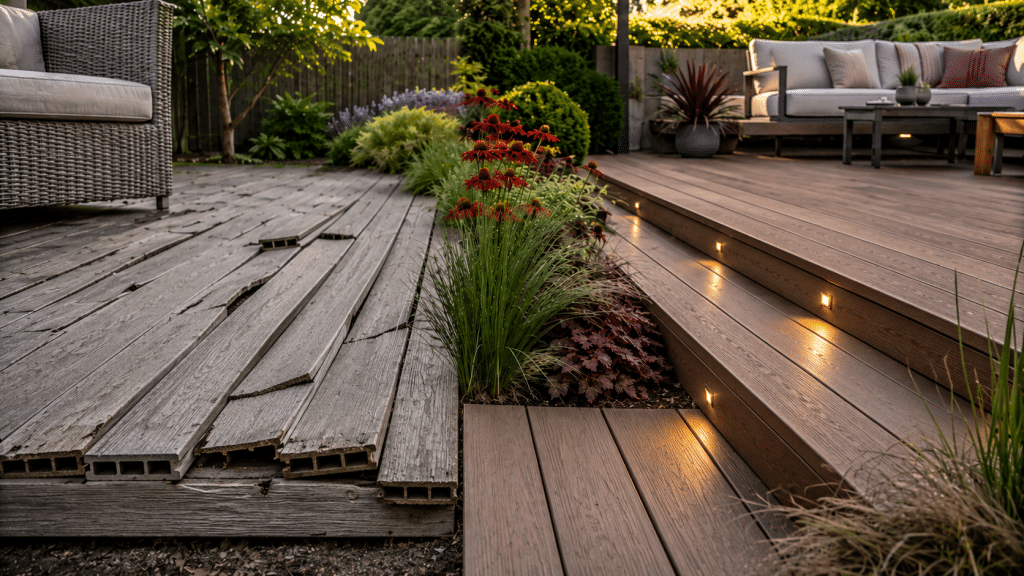


Is bad decking damaging good decking?
Pro’s Say NO to junk decking
Bad decking damages good decking because clients judge the whole category by the failures they experience.
That may sound uncomfortable, although most people in the industry know it already. Proper decking has never offered more to garden design, landscape construction and outdoor living. Yet poor products, weak specification and casual installation keep pulling the conversation backwards.
Most clients do not study board technology before they buy a deck. They rarely know the difference between low-grade imported composite, mineral-based composite, modified timber, aluminium framing, or a properly detailed structural system. Instead, they see a finished platform in the garden and expect it to perform.
When that platform moves, cracks, splits or distorts, the client does not usually blame formulation, thermal movement or supply-chain accountability. More often, they blame decking itself. That judgement then lands on every serious deck builder, including those who specify and build properly.
Cheap decking creates a false comparison
The cheap end of the market often looks convincing at quotation stage because it uses the same language as better products. A brochure may say composite decking, low maintenance and long lasting, while the price looks attractive enough to shift the conversation.
Naturally, many clients assume they have found a sensible budget version of a premium product. However, that comparison can create a serious problem because cheap composite decking may behave like a completely different material.
The surface may copy the look of better boards, but the core, filler content, polymer blend, manufacturing control and fixing behaviour can differ greatly. Those differences rarely show on day one, which makes the comparison even more dangerous.
Many low-grade boards enter the UK in huge quantities because the commercial model rewards volume. Overseas factories can produce container loads quickly, while importers and suppliers can move them through price-led channels. In some cases, those boards use virgin plastics, uncertain fillers and inconsistent blends.
Consequently, the client does not simply buy a cheaper board. They buy a different risk profile, often without anyone explaining what that risk means in a real garden.
Movement sits behind many complaints
Every decking material moves, so the issue never starts with movement alone. Timber responds to moisture, composites respond to heat, aluminium expands and contracts, and subframes react to load, water and temperature.
Good design allows for that behaviour because good design starts with the whole system. Problems begin when the movement becomes excessive, unpredictable, or poorly managed by the board and the installation method.
Some cheaper composite boards expand and contract so much that the whole deck starts to work against itself. During warm weather, gaps can close, butt joints can press together and clips can carry forces they should not carry. At the same time, screws may strain as the boards try to move.
As temperatures fall, the same boards may pull back again. Joints open, gaps become obvious and the clean finished line disappears. Before long, the deck looks unsettled rather than considered, and the client starts to question the entire project.
This is where the professional installer often gets dragged into a difficult conversation. The deck may have looked acceptable at handover, and the boards may even have photographed well. However, the real test comes later, after heat, cold, rain and foot traffic have worked through the structure for a season.
A good board should cope with ordinary site conditions when the installer follows the correct method. A poor board often turns those same conditions into a complaint.
Splitting and cracking change the client’s confidence
Splitting and cracking create a more immediate reaction because the client can see physical failure. A moving joint may irritate them, but a cracked board changes the mood of the whole project.
At that point, the client stops thinking about colour, texture and outdoor living. Instead, they start thinking about defects, safety, warranty arguments and replacement costs.
Cracks around fixings suggest stress within the board or poor compatibility with the fixing method. Split ends make the detailing look weak. Surface breakdown makes the deck feel tired long before the client expected any meaningful wear.
Because of that, reassurance alone rarely solves the problem. The client paid for an external surface that should perform, and they now see evidence that it may not. In commercial or public settings, the concern grows faster because every visible failure raises questions about risk and responsibility.
Suppliers should not treat repeated splitting, cracking and excessive movement as isolated noise. Of course, poor installation can cause failures, and nobody should ignore workmanship. However, repeated product behaviours across different projects should make the supply chain look much harder at the boards.
The environmental claim needs more honesty
Cheap composite decking often carries an easy environmental message, yet that message can collapse under basic scrutiny. Avoiding timber does not automatically make a product sustainable. Equally, plastic does not become environmentally sound because a sales brochure calls the board low maintenance.
Durability must sit at the centre of the environmental argument. A board made from virgin plastic, shipped across the world and removed early has a poor story to tell. Early failure creates waste, disposal, replacement labour, transport and another round of manufacturing.
By contrast, a deck that performs for twenty years carries a very different environmental profile. A product that allows repair, maintenance and responsible replacement deserves more respect than one heading quickly into the waste stream.
Therefore, the industry should stop confusing marketing language with environmental performance. The real question does not ask whether a board claims to be green. It asks whether the product performs long enough to justify the material, the journey and the installation.
Volume and profit cannot excuse weak products
Low-grade decking keeps entering the market because the numbers work. Containers move, stock turns quickly and suppliers can make strong margins at volume. Unfortunately, the technical risk often lands with the homeowner, the installer and the wider reputation of decking.
Some suppliers know the complaint patterns because they hear the same stories repeatedly. Clients report excessive movement, opening joints, splitting, cracking, distortion and fading. Even then, too many complaints receive the same convenient answer, which usually points back at installation.
Installation matters enormously, and poor workmanship remains one of the biggest causes of decking failure. However, product quality also matters, and repeated product behaviour cannot hide forever behind the installer.
A serious supplier should understand the boards it sells. It should know movement characteristics, fixing requirements, span limits, ventilation needs and realistic service expectations. More importantly, it should explain those matters clearly before the product reaches a client’s garden.
Selling decking should involve technical responsibility, not just stock movement.
Poor installation makes bad products worse
It would feel convenient to blame only the boards, but the UK still has too many decks built as surfaces rather than structures. A professional deck builder starts with the site, the loads, the moisture, the airflow and the frame. Only after that does the board choice become sensible.
Too many installations start the other way around. Someone chooses a cheap board first, then builds an affordable frame beneath it. Joists may lack strength, fixings may lack durability and water may sit inside the structure. At the same time, ventilation may disappear exactly where the deck needs it most.
Eventually, the weaknesses combine. A poor board moves more than expected, while a weak frame gives it little support. Unsuitable fixings then struggle to hold everything in line, and the result appears to the client as another failed deck.
Best practice should guide this work. Relevant British Standards, EC5 and manufacturer guidance should inform the frame, fixings and detailing where they apply. That should not sound excessive, because decks carry people, furniture, planters, kitchens, pergolas, balustrades and steps.
A deck becomes an external structure long before many people in the market admit it.
Real deck builders suffer from the confusion
Professional deck builders lose ground when clients compare proper systems with cheap surface work. They explain structure, drainage, ventilation, fixings, movement, board quality and long-term maintenance. Their price reflects the intention to build something durable rather than something merely photogenic.
Another quotation may then arrive with inferior boards, vague framing and weak installation methods. On paper, both prices may mention composite decking. To the client, the comparison can look simple, even though the two offers describe very different outcomes.
One contractor may price a properly designed external structure. Another may price boards on a frame. The difference becomes obvious only when the cheaper option begins to move, split, crack or feel unsafe.
By then, the damage has spread beyond one project. The client tells friends that decking caused problems. Designers become cautious, landscapers retreat to paving and architects avoid the material because they associate it with complaints.
Good decking then pays for bad decking’s failure.
The board is not the deck
The industry needs one clear line above everything else: the board is not the deck.
A decking board creates the visible surface, so clients naturally focus on colour, texture and feel. However, the deck includes the posts, beams, joists, supports, fixings, drainage, ventilation, edges, steps and balustrades. It also includes the way every part manages movement over time.
Because of that, a premium board can still fail on a poor frame. Equally, a competent board can perform far better when a skilled installer details the whole system correctly. Decking fails when people separate the surface from the structure.
That mistake has harmed the industry for years because it allows cheap boards to compete against premium systems. It also allows weak installers to compete against professional deck builders. Worst of all, it allows clients to believe all decking is broadly the same.
It is not, and the professional end of the industry should say that much more clearly.
Good decking starts with proper specification
Good decking should begin with questions rather than colours. What does the deck need to do, where will it sit, and how will people use it? Will it carry furniture, planters, lighting, balustrades, an outdoor kitchen, or a pergola?
Those questions lead to the correct specification. The board should suit the site and the expected use. The subframe should suit the exposure, ground conditions and load. Fixings should match both the board and the frame, while drainage and ventilation should support the whole structure.
Edges, steps and junctions also need careful thought because these details often reveal the difference between a board fitter and a deck builder. A clean surface means little when the structure behind it traps water, lacks restraint, or ignores movement.
Professional installers know this, serious suppliers know this, and good designers should know it too. Once the industry treats that approach as normal, poor decking will find it much harder to hide behind the language of good decking.
Designers should not fear decking
Some garden designers avoid decking because they remember poor decking, and that reaction makes sense. Many have inherited slippery softwood platforms, tired boards, failed fixings and awkward level changes. More recently, some have seen cheap composite boards move, split and disappoint clients.
Nevertheless, the answer should not involve dismissing decking as a category. A well-designed deck can solve problems paving cannot solve easily. It can manage level changes, reduce excavation and create lighter structures on difficult ground.
Furthermore, decking can connect internal and external spaces with real elegance. It can frame planting, carry lighting, support seating and form part of a complete outdoor living composition.
The question should never ask whether decking is good or bad. A better question asks which decking system suits the site, the client and the design.
Cheap decking becomes expensive when it fails
A cheap deck can look like value at quotation stage, but that value disappears quickly when the product fails. Once boards move, crack, split or distort, the client may need inspection, removal, disposal, redesign and replacement.
The emotional cost also matters. Disputes over failed garden work create stress, embarrassment and frustration. Clients feel let down, contractors feel accused and suppliers often protect their position before they protect the relationship.
Soon, everyone starts gathering photographs, emails and warranty documents, which bears no resemblance to the outdoor living dream anyone bought into.
A properly specified deck may cost more on day one, although it should carry far less risk. It should come from a credible supply chain, and it should involve a contractor who understands the complete system.
That is where real value sits.
Bad decking is the problem, not decking
Bad decking damages good decking because clients remember the failure, not the technical reason behind it. They remember the cracked board, the moving joint, the supplier who avoided responsibility and the pain of paying twice.
Therefore, the professional end of the industry must draw a clearer line. Poor-quality products should not define decking, weak frames should not define decking and vague warranties should not define decking.
Good decking deserves a better conversation. Suppliers should support what they sell, installers should build to proper standards, designers should understand decking as a system and clients should receive honest advice before they spend their money.
Decking is not dead. Bad decking is dead.
The future belongs to properly designed, properly specified and properly built outdoor structures. That is where real deck builders sit, and that is where serious manufacturers should stand.
Bad decking damages client confidence, designer trust and the reputation of professional contractors. However, good decking is not the problem.
The problem comes from everything pretending to be good decking when it offers nothing of the sort.