



The race for realistic composite decking, and whether the market actually needs another one
Not Another Deck Board?
Every now and again, another decking board appears and tells us the world has changed.
It arrives with handsome photography, a confident launch, a technical story and a promise that decking has moved on again. The surface is better, the colour is deeper, the grain is more convincing and the warranty sounds reassuring.
Quite often, the price tag has moved on as well.
To be fair, the decking industry has had to improve. It had no choice. The early composite market did not always cover itself in glory. Some boards moved too much. Others marked too easily. A few looked far too plastic, while some hollow boards performed poorly on real projects.
So, when a manufacturer develops a genuinely better deck board, I am interested. However, I am also cautious.
A new board enters the conversation
That brings me to Fiberon Novus, the new fused composite decking board launched in the United States.
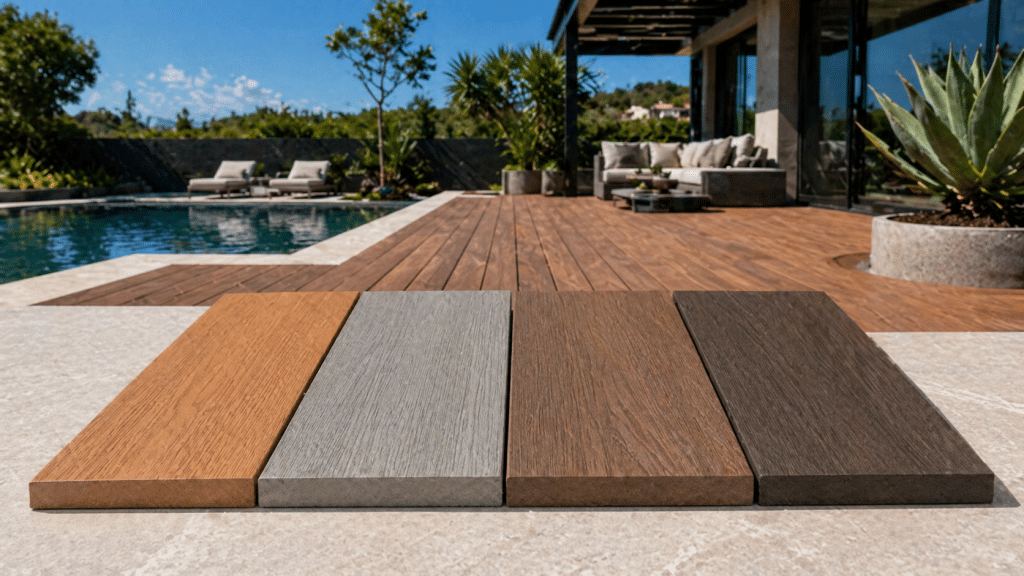
Fiberon describes Novus as a fused composite board. In simple terms, the product appears to use a protective outer shell around a composite core. The colours include Golden Cedar, Natural Ipe and Weathered Ipe, which tells us exactly where this product is aimed.
It is a synthetic board chasing the warmth, depth and variation of natural timber.
That is the current direction of travel for the premium market. Manufacturers are no longer trying to make composite decking look vaguely acceptable. They are trying to make realistic composite decking that can compete visually with timber, while promising less maintenance and better long-term performance.
And Fiberon is certainly not alone.
The surface has become the battleground
For years, people used the word “composite” as if all composite decking boards were broadly the same.
They never were.
At the lower end of the market, many boards used a mix of wood fibre, plastic and additives. Some were solid, some were hollow and some performed reasonably well. Others did not. From a distance, many looked similar. Once installed, they often behaved very differently.
Then capped composite came along and improved the market.
The idea was simple enough. Take the composite core and protect it with an outer layer. That cap helped with staining, fading and surface wear. It also allowed manufacturers to create better colours, better grain effects and a more convincing timber appearance.
Why realistic composite decking matters
The premium end of the market has moved on again.
Today, the surface of the board is where much of the battle is being fought. We are seeing high-definition timber imaging, fused shells, specialist coatings, polymer skins, PVC foam bodies, mineral fillers, ASA (Acrylonitrile Styrene Acrylate) surfaces and plenty of technical language.
Strip away the marketing, and the ambition is simple. Make a synthetic deck board look more like real timber, perform better than real timber and require less maintenance than real timber… That’s the dream.
The difficulty is that every serious manufacturer now wants to own that dream. As a result, realistic composite deckinghas become one of the most competitive areas in the decking market.
Yvyra were early to the table
This is where Yvyra deserves proper credit.
Many people in the UK domestic decking market may not immediately think of Yvyra when they talk about advanced synthetic decking. That may be because Yvyra does not always shout as loudly as some of the global giants.
However, they have been doing serious work in this space for years.
Their Exterpark Tech Supreme product was already being promoted several years ago as a highly technical, third-generation decking board. It used a PVC foam body and advanced surface technology at a time when much of the market was still trying to convince customers that ordinary composite decking was good enough.
Were Yvyra first?
I would be careful before saying Yvyra was definitely the first company in the world to do this. Unless a manufacturer confirms that directly, it is safer not to make that claim.
But were they early? Crikey, yes, Very early.
This is not a small workshop brand nervously waiting for the big names to notice them. Yvyra has been involved in major international decking projects and some very large schemes. If you check out the Middle East and find a 20,000 sq m shceme, you’ll learn that they’ve done double that. So, while they may not always dominate the UK domestic conversation, they are hardly standing at the back of the room hoping to be invited in.
Perhaps they are just the quieter giant. The one in Barcelona. The one with better shoes, better coffee and a slightly smug smile, because they were already doing this while others were still preparing the PowerPoint.
The louder race has now begun
Since then, the market has filled up.
TimberTech by AZEK has become one of the major players in the premium synthetic decking space. Its Advanced PVC decking sits away from traditional wood-plastic composite because it does not rely on wood fibre in the same way.
TimberTech has built a serious position around premium surfaces, strong warranties, colour depth, low maintenance and established technical support.
That matters.
A deck board is not just a board. It is the system behind it. The installation guidance, fixing method, warranty, stock availability and supplier support all matter when the product leaves the brochure and arrives on site.
Pioneer by Talasey
Then we have Pioneer by Talasey.
Pioneer is clearly aimed at the same premium visual-performance market. It has been promoted around high-definition woodgrain imaging and a more realistic timber appearance. Talasey is already well known in the UK landscape supply sector, so the product naturally deserves attention.
However, as always, I still want the detail.
Who manufactures it? How exactly is it made? What is the span data? How does it move? How does it cut? What happens around mitres, fascia details, steps and exposed edges?
Those questions may sound awkward. They are not.
They are exactly the questions that should be asked before any new board becomes the next big thing in realistic composite decking.
A sample board is not a deck
A sample board is not a deck.
A brochure is not a five-year exposure test. A launch event is not a south-facing terrace with planters, furniture, barbecues, dogs, children, leaves, algae and the occasional pressure washer.
Now Fiberon has entered the conversation with Novus.
Fiberon is a serious manufacturer. Novus appears to be a serious product. It sits directly in this new category of premium synthetic decking, where the board is expected to offer a highly realistic timber appearance with improved surface protection and long-term performance.
So yes, I am interested. But I am not converted yet. That takes time.
A foam board wrapped in a photograph?
There is a slightly awkward way to describe some of this new technology. Is it a foam or polymer-based board wrapped in a photograph?
That is deliberately blunt, of course. The actual chemistry and manufacturing are more complex than that. These are not simply pictures glued to planks.
However, the visual direction is hard to miss.
The new premium boards are trying to capture real timber, digitise it, reproduce it and protect it beneath advanced surface technology. In principle, that makes sense. Natural timber remains beautiful. It has depth, warmth and irregularity. Synthetic decking has spent years trying to get closer to that look.
Will it stand the test of time?
Here is the uncomfortable question.
Will this foam board wrapped in a photograph, or something close to that concept, stand the test of time?
Will it still look convincing after years of weather, foot traffic, garden furniture, cleaning, heat, shade, algae, leaves, planters and real clients? Clients are not always gentle. Nor are they always realistic.
Anyone who has worked in high-end landscaping knows that some clients will contest every mark, every movement, every colour variation and every millimetre. If the board is sold as highly realistic, highly durable and highly premium, then the expectations will be highly demanding too.
That is the trade-off. The more premium the promise, the less tolerance there is for disappointment.
Do we really need to keep updating?
This is where I struggle slightly.
Manufacturers need to innovate. Of course they do. They have competitors, distributors, sales targets, shareholders, research departments and market pressure. If they stand still, another brand will take the headline.
However, contractors, designers and homeowners do not need to chase every headline.
A deck is not a mobile phone. You do not need to upgrade it every two years because the newer version has a slightly better camera. A deck is part of a garden. In many cases, it is effectively part of the building. It needs to be safe, stable, durable, attractive and appropriate.
Proven products still matter
New products matter, but proven products matter more.
That is where established boards still have a strong argument. If a product already performs well, installs well, looks good and has a sensible price, why abandon it just because another board has arrived with a sharper launch campaign?
Perhaps the proven product will rule the roost. Not because it is the newest. Because it has the best balance of aesthetics, performance and price.
That is often what wins in the real world. It is also where realistic composite decking must be judged carefully. A product should not win because it is new. It should win because it performs.
The market is becoming noisy
The premium decking market is now crowded.
Some products are excellent, some are good some are average. Others are ordinary products with above-average marketing.
That may sound harsh, but it is true.
The customer sees composite decking, capped decking, PVC decking, mineral composite decking, bamboo composite decking, fused composite decking and advanced composite decking. Then they see long warranties, realistic woodgrain, stain resistance, slip resistance, scratch resistance and low maintenance.
After a while, it all becomes noise. Noise can make the wrong board look like the right board. It can make an average product look similar to a good one. It can also make price harder to understand.
The right question to ask
Contractors and designers need to stay disciplined.
The question should not be, “What is the newest board?” The better question is, “What is the right board for this project?” That is a very different conversation.
A premium board has to suit the site, the client, the exposure, the substructure, the fixing system and the budget. If it does not, it may become an expensive mistake rather than an upgrade.
This is especially true with realistic composite decking, because the more sophisticated the product appears, the more the client may expect from it.
That expectation must be managed before the first board is installed.
I wonder who will launch this next
This is the part I am now watching with interest. I wonder who will launch this next, because someone will.
If the market responds well to boards like Exterpark Tech Supreme, Pioneer, TimberTech Advanced PVC and Fiberon Novus, other manufacturers will not sit quietly in the corner.
They will develop their own version. It may have a different name. It may use slightly different chemistry. The surface may be described as a cap, wrap, shell, film, print, scan, coating or fused layer.
But the direction will be the same. More realism, more performance, more premium positioning and more cost.
And then, inevitably, more confusion.
Does every project need it?
At some point, the market may need to take a breath.
Not every project needs the newest surface. Nor every garden needs the most realistic hardwood effect. Not every client needs to pay for the highest tier of synthetic decking.
Sometimes the best choice is a product that is already known, already proven and already sensible.
That is not boring. That is professional judgement.
The challenge for realistic composite decking is not simply whether it looks good in a sample box. The challenge is whether it delivers enough value on the right project, for the right client, at the right price.
Are these boards now too expensive?
Some probably are. Not all of them. But some.
A premium board can absolutely justify a premium price. On the right scheme, the material cost may make sense. A luxury roof terrace, a high-end residential garden, a hotel, a commercial boardwalk or a heavily used hospitality space may all benefit from a better board.
If the product reduces maintenance, improves long-term appearance and performs well under pressure, the price may be justified. However, there is still a ceiling.
When synthetic decking becomes too expensive, it starts competing with other serious materials. Clients may begin to consider hardwood, modified timber, aluminium systems, mineral-based composites or other specialist products.
Looking like timber is not enough
At that point, the board has to work harder.
It cannot simply say, “I look like wood.” That is not enough.
It has to prove why it deserves the money. It has to prove it through performance, detailing, stability, installation, availability, technical support and aftercare.
The most expensive board is not automatically the best board. Sometimes it is just the most expensive board.
This is where the market needs honesty. If realistic composite decking costs significantly more than other strong options, the value must be clear. Otherwise, the product risks becoming desirable, but not sensible.
The real test is not the launch
A deck board is not proven at launch. It is not proven in a sample box. Exhibition lighting does not prove it either. A press release can explain the ambition, but it cannot prove the outcome.
The board is proven on site. It is proven after summer heat, winter rain, furniture movement, food spills, cleaning, shade, algae, awkward details and client use.
It is proven when the installer can work with it properly. The supplier also has to support it properly.
If a damaged board can be replaced, the warranty still makes sense and the product remains available, then confidence grows.
That is where the truth usually turns up.
My view
I welcome innovation. Better surfaces are welcome. Improved stability is welcome. Better slip resistance, better realism and better long-term performance are all welcome.
I also welcome manufacturers that invest properly in research and development. But I do not welcome hype for the sake of hype.
Fiberon Novus looks interesting.
Pioneer by Talasey looks interesting.
TimberTech by AZEK remains a serious player.
Exterpark Tech Supreme by Yvyra deserves proper recognition for being early, ambitious and technically interesting long before some of the louder global conversations started.
However, no board gets a free pass.
Not Fiberon, Not Talasey, Not TimberTech, Not Yvyra. Not anyone.
What the industry really needs
The industry does not need more vague claims. It needs clearer information, better installation guidance, honest warranties and stronger technical support.
It also needs contractors who are prepared to say, “No, that is not the right board for this project.” That is where experience matters.
A good contractor does not simply follow the newest product launch. They consider the project, the budget, the client and the long-term risk. Then they recommend the right material for the job.
That may be a new board. It may also be a proven one. Either way, the decision should come from judgement, not noise.
Final thought
So, not another deck board? Actually, yes. Another deck board is welcome if it genuinely improves the market.
However, better marketing is not enough. The board must perform. It must install well, must be supported properly, must remain available and it must justify its price. Above all, it must suit the project.
The premium decking market is becoming more advanced. It is also becoming more crowded, more expensive and harder for homeowners to understand.
That is why independent judgement matters. Because in decking, the board is only part of the story. The real success comes from the right product, installed in the right way, on the right structure, for the right client.
Innovation is welcome… Hype is not.
Leave a comment
You must be logged in to post a comment.
1 thought on “The race for realistic composite decking, and whether the market actually needs another one”
Well considered article young Karl.Not sure this helps but…PVC was used in WPC production as far back as 1997 with Celluar products being driven firstly by Westlake in the USA through their Zuri range. A fabulous product that was never given enough funding.
Move a few more years and we are again seeing PVC raising its head mainly due to its fire properties relative to PE and PP again driven by demand and legislation from California and Australia. You can wrap it in an ew coat of acrylic, Asa, San or whatever but it is still PVC and has attendance to move one extreme conditions. Trapping it a new coat does not stop that desire for freedom but it may add a failure risk percentage no body wants.
The Azek products are well tried and tested as some of the newer stuff mis not too shabby but technology moves at pace and already theses are being out-gunned by additive innovations push performance even higher.
PVC works well, when there is a fire risk element to consider and any high level of excessive moisture to consider but it comes down to application. budget and aesthetics in the end. Remember Acrylic, ASA and SAN scratch quite easily so for the risk is medium term looks as opposed to short term beauty. Think hard also when being told that recycled PVC is being used as it is more Likely to a % of recycled and not 100% so can be misleading soldier PVC contained Lead our Cadmium which to day is biog no no.
As the range of materials, increases and technology moves on the test will through which manufacturers truly offer, support and deliver on their warrantees which today are generally quite poor.
Pick your weapon carefully.