


Your decking can become much hotter than the air around it
A garden deck can feel pleasantly warm in spring and uncomfortably hot during a summer afternoon. This often surprises homeowners because the weather forecast may say 28°C while the surface beneath their feet feels considerably hotter. So ask yourself ” why does decking get hot “.
The forecast reports air temperature from a thermometer kept in shaded, ventilated conditions. Your decking lies beneath direct sunlight and absorbs solar energy hour after hour. Those are two completely different measurements.
It is therefore perfectly possible for a deck board to become much hotter than the surrounding air. Timber, wood-plastic composite, mineral-based composite, PVC, porcelain, stone and artificial grass can all do it. No outdoor surface exposed to strong sunshine is automatically cool.
The important question is not simply whether a product becomes hot. Homeowners need to know how its colour, composition, location and exposure influence the temperature, and what a manufacturer really means when it describes a board as cooler or heat mitigating.
The short answer: decking gets hot because it absorbs energy from sunlight faster than it can release that heat into the air and its surroundings. Dark colour, prolonged direct sun, still air and the board’s particular construction can all increase the surface temperature.
Why air temperature and deck temperature are not the same
Sunlight contains visible light and infrared radiation. When that energy reaches a deck, the surface reflects part of it and absorbs the rest. The absorbed energy then becomes heat.
At the same time, the board loses heat through moving air, radiation to the sky and conduction into the structure beneath it. Its temperature continues to rise until the energy arriving and the energy leaving reach a temporary balance.
That balance changes constantly. A passing cloud can reduce the incoming solar energy almost immediately. A breeze can carry more heat away. Shade from a tree, parasol or building can dramatically reduce the heat reaching the surface. This explains why two parts of the same deck can feel very different beneath bare feet.
It also explains why nobody should present a single temperature reading as a universal product rating. A meaningful comparison would need to control, or at least record:
- air temperature and humidity;
- strength and duration of solar exposure;
- time of day and angle of the sun;
- wind speed;
- board colour and surface finish;
- board orientation and the surface beneath it;
- whether the samples began at the same temperature; and
- the measuring instrument, distance and emissivity setting.
Without those details, a photograph of an infrared thermometer may be interesting, but it is not reliable proof that one entire product range is cooler than another.
Is composite decking hotter than timber?
Sometimes, but you cannot safely apply that rule to every board.
Traditional wood-plastic composite contains wood fibre and polymer. Different products use different proportions, cap materials, pigments, profiles and densities. Mineral-based composites and wood-free resin boards use quite different technologies again. Calling all of them “composite decking” hides substantial differences.
Timber also varies. Pale pressure-treated pine, dark tropical hardwood and modified timber do not absorb and transfer heat identically. A timber deck may also change colour considerably as it weathers, which can alter its response to sunlight.
In practice, colour and solar reflectance can be at least as important as the broad material label. A pale composite with an infrared-reflective cap may remain cooler than a dark composite. A dark board of almost any material is likely to absorb more solar energy than a genuinely light alternative, although composition, texture and coating still matter.
Timber often feels different because wood is a relatively poor conductor of heat. However, “feels cooler” and “has a lower measured surface temperature” are not always the same proposition. The rate at which heat passes from a material into your skin also affects the sensation.
What does heat-mitigating technology actually mean?
Heat mitigation usually means that the manufacturer has altered a board or its cap so that it reflects more solar energy, particularly infrared radiation, or absorbs less heat than a stated reference product.
It does not mean the deck remains cold. It does not mean it will always be safe for bare feet, children or pets. It does not make a 38°C day feel like a 20°C day.
Imagine placing two boards beneath the same strong sunshine. The reference board reaches 65°C and the heat-mitigating board reaches 50°C under that particular test. The second board is a very meaningful 15°C cooler, but 50°C is still hot. The improvement is real; the description “cool decking” could still give a homeowner the wrong impression.
This is why every percentage or temperature-reduction claim needs four questions:
- Cooler than which product?
- Did the test compare similar colours?
- Under what test conditions?
- Is the figure a typical result or the largest reduction achieved?
A claim of “up to 20°C cooler” does not mean the board will be 20°C cooler in every garden. “Up to” describes the best result within the stated testing, while the actual difference may change with colour, exposure, weather and use.
Comparing five decking choices honestly
The currently published information does not support a scientifically valid hottest-to-coolest league table. The manufacturers do not all publish results from the same test method, reference board, colour or conditions.
That absence of comparable data is itself useful information for a homeowner. It prevents a marketing phrase from becoming a false numerical comparison.
| Decking product | Construction or technology | What the evidence supports | What it does not establish |
|---|---|---|---|
| Deckorators Excursion | Surestone mineral-based composite with a polymer cap. The UK brand information says reflective caps reduce surface heat. | Deckorators designed it to limit heat gain and feel cooler than conventional alternatives without equivalent reflective technology. | Deckorators does not publish an independently comparable UK temperature figure covering the other products in this table. |
| Trex Signature | Wood-plastic composite with a protective surface and highly realistic appearance. | Trex states that darker colours feel hotter and advises heat-conscious customers to choose a lighter colour or heat-mitigating product. | Trex does not describe Signature as its heat-mitigating range. Its UK evidence identifies Transcend Lineage for that purpose. |
| Elements by Composite Prime | Advanced-polymer decking rather than conventional wood-plastic composite. Its guidance recognises that direct sunlight increases board temperature. | The installation guidance recognises solar heating and thermal movement. Composite Prime also advises lighter colours and shade. | Composite Prime does not publish a like-for-like temperature reduction against the other named products. |
Millboard and Kebony: what the evidence supports
The following entries complete the five-product comparison. They follow the same evidence test rather than assuming that every composite or timber board behaves alike.
| Decking product | Construction or technology | What the evidence supports | What it does not establish |
|---|---|---|---|
| Millboard Enhanced Grain | Wood-free, fibre-reinforced resin and mineral composite with a moulded surface. | Millboard acknowledges that its boards can become hotter than wood in direct sunlight and that darker colours feel hotter. | Millboard does not publish a heat-reduction percentage comparable with Trex’s laboratory claim. |
| Kebony | Real timber modified with furfuryl alcohol rather than plastic composite decking. | It retains the thermal behaviour of real timber and suits exposed exterior use. Colour and solar exposure will still affect surface heat. | Kebony does not publish a directly comparable temperature test covering these exact five products. |
A necessary note about Trex
Trex states that its SunComfortable technology can reduce heat build-up by up to 20°C compared with its original boards. Its laboratory test simulated full summer sun at noon over an extended period. Trex also expressly warns that the boards will still become hot in direct sunshine and identifies Transcend Lineage as its coolest range.
That is a potentially substantial reduction, but it does not measure Trex Signature against Deckorators Excursion, Elements, Millboard Enhanced Grain or Kebony. We must not convert it into one.
A necessary note about Deckorators
Deckorators describes the cap used with Surestone technology as containing infrared-reflective materials intended to limit solar heat gain. Its UK website also describes Excursion as heat resistant and says its reflective cap produces a cooler board feel.
That supports a genuine product feature. However, without a shared test protocol and published readings for all the boards, it does not prove that every Excursion colour is cooler than every competing product in every situation.
Why colour matters so much
Dark surfaces generally absorb a greater proportion of the sun’s energy, while lighter surfaces reflect more of it. That is why a charcoal board and a pale grey board from the same collection may perform quite differently.
Homeowners often choose from a small sample indoors, where artificial light changes our perception of colour and temperature remains irrelevant. That approach tells us too little about a south-facing deck receiving uninterrupted afternoon sun.
Request several samples and place them in the actual proposed location. Compare them at midday and during the hottest part of the afternoon. Leave them long enough to reach a reasonably stable temperature, and touch them cautiously with a hand before considering bare feet.
This will not produce laboratory data, but it will answer the question that matters most: how do these particular colours behave in your garden?
A homeowner’s guide through the seasons
Decking temperature is not solely a July or August subject. The sun angle, shade pattern, moisture and the way you use the garden change throughout the year.
| Season | What happens on the deck | What homeowners should consider |
|---|---|---|
| Spring | Air may remain cool while strengthening sunshine warms dark boards surprisingly quickly. | Test samples in the proposed position and clear winter dirt and organic growth. |
| Summer | Long periods of direct solar exposure can drive the surface far above the reported air temperature. | Provide shade, choose colour carefully, wear footwear and test the surface before children or pets use it. |
| Autumn | Peak heat usually reduces, while leaves, moisture and lower sun create different comfort and slip issues. | Keep the surface clear, preserve drainage gaps and remember that low-angle sunlight can still warm wet decking. |
| Winter | Solar heating weakens, but sunny areas may thaw before shaded areas. Frost and ice become the greater risk. | Check the whole deck and follow the manufacturer’s approved cleaning and de-icing methods. |
Start a cooler deck with colour and shade
The most reliable heat-reduction strategy stops intense sunlight from reaching the boards. Product technology can help, but thoughtful garden design often produces a larger and more dependable improvement.
Choose a lighter colour
If the deck will sit in strong, uninterrupted sun, begin with the lighter colours in each suitable product range. Do not compare colour names alone: “oak”, “stone” and “silver” can look quite different between manufacturers.
Plan shade before construction
A pergola, retractable awning, parasol, sail or carefully positioned tree can protect seating and circulation areas. Plan that shade during the design stage instead of adding it as an emergency response after the first heatwave.
Match the deck to the garden’s orientation
A deck outside north-facing doors behaves differently from an elevated, south- or west-facing terrace. Afternoon sun can prove particularly influential because the boards may already have absorbed energy for several hours.
Keep air moving around the structure
Ventilation beneath and around a deck matters for many reasons, including moisture management. Moving air can also help remove heat. It will not overcome strong solar gain, but a tightly enclosed structure will behave differently from an open, well-ventilated one.
Protect the people and pets who use the deck
Create a practical route across the deck
Where children, older people or pets will move between the house, lawn and pool, consider how they will cross the space on the hottest day. A shaded route may matter more than achieving the lowest possible average temperature across the whole deck.
Treat rugs and water with care
An outdoor rug can shade the boards beneath it, although it may trap moisture, affect weathering or create uneven colour. Check the decking manufacturer’s advice and move the rug periodically where appropriate.
Lightly wetting a suitable deck can reduce its temperature temporarily through evaporation, but it is not a permanent solution. It can also introduce a slip risk, and hot water from a hose left in the sun can be dangerous. Always check the surface and follow the manufacturer’s care guidance.
Children, pets and bare feet
Adults can quickly step away from an uncomfortable surface. A crawling child, a person with reduced sensation or mobility, and a pet may not respond as quickly.
On a hot, sunny day:
- test the deck cautiously before allowing prolonged skin contact;
- provide shade rather than relying solely on a product description;
- leave footwear near the doors used to access the deck;
- provide a shaded route and resting place for pets;
- remember that darker borders may be hotter than the main deck; and
- never assume that “heat resistant” means burn proof.
If you cannot keep your hand comfortably against the surface, do not let unprotected feet or paws remain on it.
What should you ask before buying decking?
Ask the supplier or installer:
- Does this exact collection use heat-mitigating technology?
- Which colours perform best in direct sun?
- Is there a published test report or only a general marketing statement?
- What product and colour formed the comparison?
- Did the manufacturer measure the results in a laboratory or outdoors?
- Does the manufacturer warn about exposed skin, children or pets?
- Can I test samples in my own garden before ordering?
A knowledgeable installer should welcome those questions. They do not attempt to catch anyone out; they help the designer specify a deck that suits the garden’s exposure and your intended use.
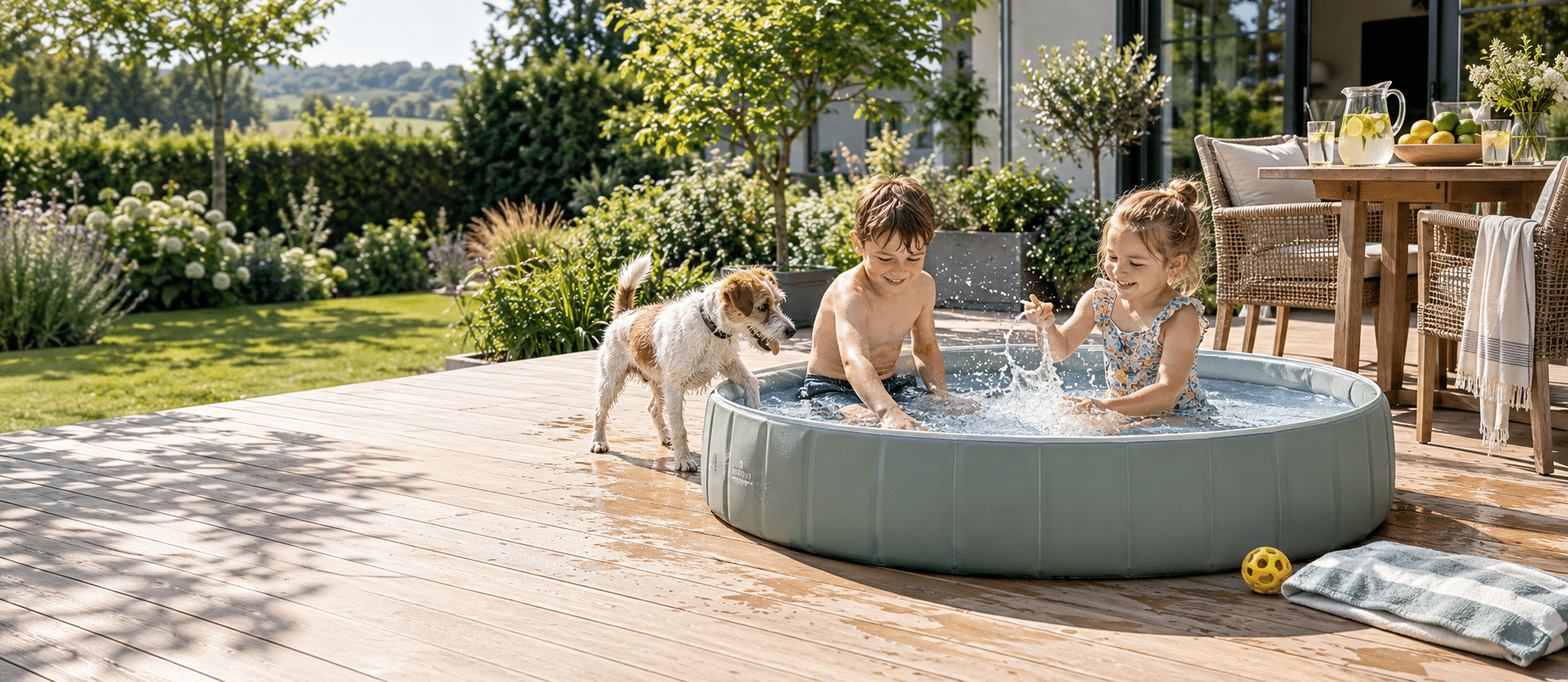
So, which decking stays coolest?
No honest universal winner exists without a controlled, like-for-like test of the exact boards and colours under consideration.
Kebony provides the familiar touch and thermal behaviour of real timber. Millboard Enhanced Grain, Elements, Trex Signature and Deckorators Excursion all have distinct constructions, so we should not treat them as interchangeable examples of “composite”. Deckorators supports Excursion with a reflective-cap heat claim, while Trex applies its quantified UK heat-mitigation claim to SunComfortable products, particularly Transcend Lineage, rather than Signature.
For most homeowners, the best decision will combine:
- a product suitable for the application;
- the lightest colour compatible with the design;
- samples tested in the real location;
- planned shade during the hottest part of the day; and
- realistic expectations about every outdoor surface in strong sunshine.
Heat-mitigating technology can make a worthwhile difference. It cannot repeal the physics of a cloudless summer afternoon.
Frequently asked questions
Why does decking feel hotter than the air temperature?
Weather stations measure air temperature in shaded, ventilated conditions. Decking in direct sun absorbs solar radiation, so its surface can become considerably hotter than the surrounding air.
Is timber decking always cooler than composite?
No. Timber frequently feels cooler, but performance changes with species, colour, moisture, finish and exposure. Composite boards also vary significantly in their material, cap and pigment. Compare exact products and colours rather than material names alone.
Does grey decking get hotter than brown decking?
Lightness and solar reflectance matter more than whether the colour is called grey or brown. A dark grey may become hotter than a pale brown, while surface technology can alter the result again.
Does heat-resistant decking stay cool on a 38°C day?
No homeowner should interpret a manufacturer’s claim that way. A heat-mitigating board may remain materially cooler than its reference product and still become uncomfortably hot during intense sunshine.
What is the easiest way to keep decking cooler?
Prevent direct solar exposure. A well-positioned awning, pergola, parasol, shade sail or tree can provide a more predictable benefit than relying on board technology alone.
Should I test decking samples before buying?
Yes. Put the actual colours in the intended location and compare them during sustained sunshine. Samples do not replace controlled testing, but they provide valuable evidence of how the boards behave in your garden.
Technical references and manufacturer information
- Deckorators UK — Excursion Decking
- Deckorators — Surestone Technology
- Trex UK — Heat-Mitigating Decking and SunComfortable Technology
- Trex — Signature Decking
- Composite Prime — Elements Installation Guide
- Composite Prime — Keeping a Composite Deck Cool During a Heatwave
- Millboard — Frequently Asked Questions
- Kebony — Decking and Cladding in Hot Climates
Editorial note: The comparison reflects publicly available product information that we checked on 9 September 2026. Manufacturer ranges and technical claims may change. We found no common independent test covering all five named products, so the article deliberately avoids manufacturing a numerical league table from incompatible evidence.