


“Has this particular hanger been specified for the conditions beneath an outdoor deck?”
The Decking Network compared current merchant listings with manufacturers’ own product information. What we found is a useful reminder that two similar looking hangers can have very different stated applications.
A hanger that says “decking” — and service class 2
Consider TIMCO’s 47 mm galvanised mini timber hanger, product code 47THM. The manufacturer describes it as a light duty connection for applications including loft hatches and decking. It is made from pre-galvanised carbon steel.
Read further down the same specification, however, and you find service class 2. TIMCO rates its corrosion resistance for occasionally damp or wet conditions in rural and sheltered areas.
That does not mean every use of this hanger in something called a deck is automatically wrong. A sheltered connection and a hanger beneath an exposed garden deck may experience very different conditions. It does mean that the word “decking” should not be read as blanket approval for every outdoor installation.
This is where a hurried purchase can go astray. The product description suggests an application; the technical specification sets the limits that need checking.
The similar looking hanger with a different rating
TIMCO also sells a 47 mm A2 stainless steel mini timber hanger, product code 47THMS. It serves the same nominal joist width and is also described for light duty applications including decking. This version is listed for service class 3.
Here is the revealing detail: both product pages state a steel thickness of 1 mm. The difference cannot be settled by feeling which one seems heavier. They are distinct products with distinct specifications, despite their similar purpose and width.
The stainless model provides a documented example of a mini hanger rated for service class 3. It is still described as light duty. Its material and service class do not, by themselves, prove that it has enough capacity for a particular deck. Joist size, span, loading, supporting member and the complete connection must also be checked.
What does service class 3 mean?
Eurocode 5, BS EN 1995-1-1, is the framework used to design timber structures. Its service classes account for the moisture conditions affecting the timber and its connections. Service class 3 addresses conditions beyond those covered by the first two classes and is the relevant starting point for an exposed deck connection.
A joist can have appropriate exterior timber treatment while its metal connector remains incorrectly specified. Eurocode 5 also requires metal fasteners and connectors to be inherently corrosion resistant or protected against corrosion. Its guidance varies with the type of metal component and the service conditions. There is no rule that every outdoor hanger must be stainless steel, nor does the word galvanised alone establish that a particular hanger will last in a particular position.
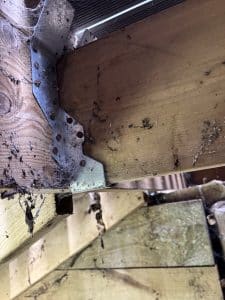
How long will a service class 2 hanger last outside?
There is no honest number of years we can give you. Service class 2 is an exposure designation, not a countdown clock. A hanger under a well-ventilated, sheltered structure could behave differently from one repeatedly soaked beneath a low deck.
Where corrosion advances, the hanger or its nails can lose the capacity needed to support the joist. If several connections deteriorate, particularly on a raised deck, the result could be sudden and potentially catastrophic structural failure. The sensible question is whether the whole connection has been specified for its actual exposure before anyone builds over it.
What the merchant description leaves out
A mini hanger currently listed by Toolstation provides another example. Its listing describes a 0.8 mm galvanised steel hanger for light duty uses such as trimming around ceiling hatches. It also says that hangers of this kind are commonly used for decking.
“Commonly used” tells us what people do. It does not tell us the service class of that specific product, its suitability for the exposure beneath your deck, or the capacity of the proposed connection. The merchant listing does not provide a service class. Before specifying that hanger for an exposed deck, an installer needs the manufacturer’s applicable technical information.
That is a distinction worth making fairly. We have not established that the Toolstation product is defective. We have established that its short retail description does not answer the question an installer must ask.
Is thicker steel the answer?
Thickness matters to a hanger’s structural design, but it is a poor shortcut for judging corrosion resistance.
One hanger might use thinner steel with a suitable material or protective coating; another might be thicker but intended for a different environment. Shape, folds, nail holes and fixing arrangement also affect performance. Even within one manufacturer’s range, products that accept the same width of joist can have different dimensions and capacities.
The nails are part of the specification
The hanger does not work alone. Its rated performance depends on transferring load through the specified fixings into the supporting timber and the joist.
For example, Simpson Strong-Tie’s JHA adjustable hanger is explicitly labelled indoor, service class 2. Its published performance values are based on 3.75 × 30 mm square twist nails. Replacing specified connector nails with whatever screws are in the van does not preserve the tested connection.
The fixing must also suit the environment and the hanger material. TIMCO’s installation guidance, for example, specifies different nails for its galvanised and stainless steel applications. Mixing metals without checking compatibility can create an additional corrosion concern.
Treated timber adds another question
The timber around an exterior connection may stay damp for long periods, particularly where construction traps water against the hanger. Preservative treatment can also affect the metal in contact with it.
Simpson Strong-Tie warns that pressure treated timber can be corrosive to zinc coated steel under certain conditions and advises against placing galvanised connectors against treated wood that has not been properly dried. This is a reason to check compatibility with the particular timber and treatment, rather than assuming that “galvanised” settles the matter.
So what should you ask at the counter?
Identify the exact product code, then establish:
- Is the hanger intended for timber to timber, timber to masonry, or another connection?
- What service class and exposure does the manufacturer state?
- What is its material or coating specification?
- What load can it carry with the specified fixings and installation arrangement?
- Which nails or connector screws are required, and are they suitable for the hanger, timber and site conditions?
For coastal sites, unusually wet details or more corrosive timbers, the answer may require further advice from the hanger manufacturer or a structural designer.
A joist hanger is a small purchase in the cost of a deck. It is also the point at which a supported joist passes its load into the rest of the frame. That is why the useful question is never simply, “Is it galvanised?” It is: “Can you show me that this hanger, fixed this way, is suitable for this deck?”