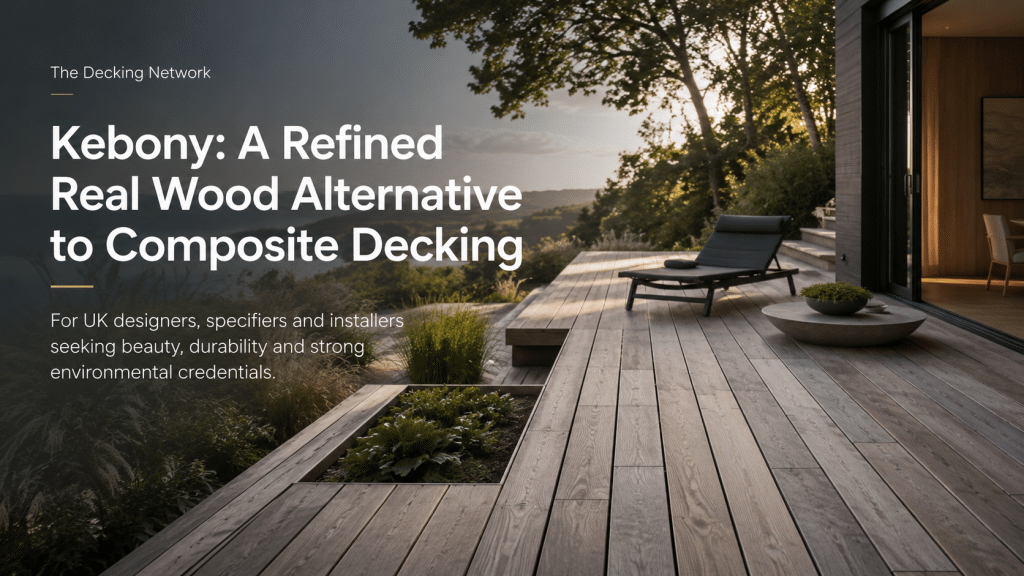


Kebony sustainable decking UK: The real wood alternative designers should be specifying
This may be the decking solution the UK composite market has been searching for
There is a moment in many garden design conversations when the client says, “I think we want composite decking. Is Kebony Sustainable Decking something you’ve missed in the UK?
That sentence usually comes from a sensible place. They want something durable. They want something that will not demand constant maintenance. They may have seen a neighbour’s old softwood deck turn slippery, split, twist or fade badly, and they do not want to repeat that mistake.
So, composite appears to be the obvious answer.
Yet there is another question worth asking before the specification moves too quickly.
Have you considered Kebony?
Kebony is not a plastic-looking imitation of timber. It is real wood, modified for external performance, and it gives the designer, specifier, decking installer and professional landscaper something genuinely useful to talk about. It offers warmth, character, strong environmental credentials and a refined appearance that suits properly designed gardens.
For many UK projects, it may be the missing link between natural timber and the modern expectation of durability.
Why Kebony deserves a serious place in UK garden design
The decking industry has spent years pushing clients towards a choice between traditional timber and composite. That has created a rather limited conversation.
Traditional softwood can look lovely at first, but many clients worry about movement, maintenance, slipperiness and long-term decay. Composite can solve some of those concerns, although it often brings other questions around heat, appearance, movement, recycling, surface character and whether the board truly belongs in a high-end garden.
Kebony sits in a much more interesting position. Kebony Sustainable Decking for the UK garden is here to stay
It starts as real wood. Then it goes through a modification process that changes the cell structure of the timber and improves its external performance. The result is a board that still feels natural, still smells like timber and still has the visual richness that designers want, but with a much stronger durability story than ordinary softwood decking.
That is why it deserves more attention from garden designers, landscape architects, specifiers, decking installers and professional landscapers.
It does not ask the designer to give up beauty for performance. Equally, it does not ask the client to accept a synthetic appearance in exchange for lower maintenance. Instead, it gives both parties a more balanced answer.
The first thing people notice is the colour
Fresh Kebony has a beautiful, rich, dark brown colour. It feels refined, calm and expensive without becoming loud.
That matters because decking rarely sits on its own. It has to work with planting, stone, clay pavers, porcelain, brick, steel, glass, furniture, lighting and architecture. A poor decking choice can make a carefully designed garden feel ordinary, even when everything else has been considered.
Kebony brings depth.
Against soft planting, the colour gives contrast. Near contemporary glazing, it introduces warmth. Beside natural stone, it feels grounded and elegant. When paired with black metalwork or architectural detailing, it can look sharp, modern and quietly luxurious.
Over time, Kebony will weather towards a silver-grey patina if left untreated. That gives designers another useful conversation with the client. Some projects may suit the original darker tone, maintained through suitable care. Others may look better as the timber softens and silvers with age.
Either way, the material has character. It does not look flat. It does not feel generic. Most importantly, it does not look like a compromise.
A sustainable story that clients can actually understand
Many clients now ask about sustainability, but they do not always know what a good answer sounds like. They may say they want recycled materials, or they may ask for composite because they believe it must be the greener option.
That is where the conversation needs more care.

A sustainable deck is not only about what a board is made from. It is also about responsible sourcing, service life, repairability, performance, maintenance, transport, replacement cycles and whether the material still looks good enough to keep.
Kebony gives professionals a strong story to explain.
It uses sustainably sourced timber and a bio-based modification process. It also offers a serious alternative to tropical hardwood, which has long been admired for beauty and durability but carries obvious environmental concerns when poorly sourced or irresponsibly specified.
For a designer, that means Kebony can deliver the look and feel of a premium timber without pushing the project towards vulnerable tropical species. For a professional landscaper, it creates a more intelligent sales conversation. The client can still have a beautiful timber deck, but with a material that feels aligned with modern environmental expectations.
That is why Kebony should not sit quietly in the background. It deserves to be part of the early design conversation.
Why installers tend to enjoy Kebony
Installers know the truth about materials long before the brochure does.
They know which boards feel brittle. They know which products mark too easily. They know which materials fight the saw, which ones split, and which ones need so many caveats that the installation becomes awkward.
Kebony has a very different feel. Karl Harrison said “Kebony Sustainable Decking feels luxurious as is a must for professionally designed gardens in the UK”.
There is a pleasure in working with it because it behaves like a proper piece of timber. It has weight, smell, grain and presence. When it is cut, that rich aroma comes through immediately. It is sweet, warm and almost caramel-like, rather like walking into a sweetshop when you were a child.
That may sound romantic, but it matters.
Good installers care about the materials they handle. They notice when a board feels premium. They understand when a product rewards accurate cutting, careful fixing and clean detailing. Kebony gives that sense of craft back to decking, which is something the industry should value more than it currently does.
It is not just a board to lay. It is a material to build with.
The professional opportunity: use Kebony before the client asks for it
Most clients will not ask for Kebony by name. That does not mean they would not choose it.
Clients often ask for the product category they already know. If they have heard about composite decking, they ask for composite decking. If they have seen porcelain patios on Instagram, they ask for porcelain. The professional’s role is not simply to accept that first request. It is to guide the client towards the right material for the design, the setting and the long-term use of the space.
That is where Kebony becomes powerful.
When a client says, “We want composite,” the response does not need to be confrontational. It can be simple, professional and helpful.
“You may still choose composite, but before we decide, you should look at Kebony. It gives you real timber, a beautiful dark colour, strong durability and a much better sustainability story than many people expect from decking.”
That kind of sentence changes the tone of the meeting.
It tells the client that the designer or installer is thinking beyond the obvious answer. It also opens the door to a more considered specification, where the deck forms part of the wider garden rather than becoming a product bolted onto the design.
Kebony has already proved itself in the UK
Kebony is not a new experiment. It has been available in the UK for years and has already appeared in strong residential, commercial and architectural settings.
That matters because professional specifiers need confidence. They need to know that a material has moved beyond novelty. They want evidence, precedent and a sense that the product can sit comfortably in a serious scheme.
Kebony has that.
It has been used on high-quality external projects, including architectural schemes where appearance, sustainability and detailing all matter. It has also featured in specialist decking discussions and project write-ups for years, which means the industry has had plenty of time to understand it.
The question now is not whether Kebony exists.
The better question is why more designers, specifiers and professional landscapers are not using it more often.
A better answer for designed outdoor living
Decking has changed.
The best schemes no longer treat a deck as a rectangle of boards at the back of a house. A well-designed deck now forms part of a complete external room. It may connect the kitchen to the garden, wrap around planting, frame a view, support furniture, integrate lighting, meet steps, work with balustrades or sit beneath a pergola.
In that kind of setting, the material choice becomes much more important.
Kebony suits this more grown-up version of decking because it has design value as well as technical value. It can soften hard architecture. It can make a contemporary garden feel warmer. When used carefully, it can help a terrace feel calm, natural and luxurious without looking forced.
That is why it deserves attention from the design community first.
Installers can build with it. Landscapers can sell it. Specifiers can justify it. But designers can make it desirable.
Reference project may be found here… Go on, take a look
By Karl Harrison were he has designed a luxury outdoor living space using Kebony as the main feature
Designed By Stanton Williams with Kebony at the Royal Opera House
By OKOPOD a garden room and deck in Kebony
The UK decking industry should talk about Kebony with more confidence
Kebony has almost everything the modern decking conversation needs.
It gives clients real wood, not an imitation of wood. The colour starts rich, dark and refined, which makes it immediately attractive in high-quality garden design. Its environmental credentials also give designers and specifiers a stronger story than many standard decking options can offer.
For installers, the appeal goes beyond the brochure. This is a material that feels enjoyable to handle, cut and fix. It smells like proper timber, looks luxurious on the frame and gives the finished deck a depth that many synthetic boards struggle to achieve.
Professional landscapers also gain a better answer when a client asks for composite decking. Rather than simply accepting the first material category mentioned, they can introduce Kebony as a natural, durable and sustainable alternative. That moves the conversation away from “which board is cheapest?” and towards “which material is right for this garden?”
The UK has been searching for a decking material that can answer the composite question without abandoning the soul of timber. Kebony may already be that answer. It has simply been waiting for more designers, specifiers, decking installers and professional landscapers to start using it properly.
So next time a client says, “We want composite decking,” there is a better reply.
“Have you considered Kebony?”
That one question could change the whole project.