

Why do some Garden Designers avoid decking?
Decking still divides opinion.
Some garden designers avoid decking completely. Some garden designers love it. few will only use it when the site gives them no better option.
That reaction did not come from nowhere. Over the years, many designers have seen poor decking. They have seen rotten timber frames, slippery boards, badly fixed composites, weak steps, unsafe edges and awkward platforms that look disconnected from the garden.
So, I understand the concern.
However, I do not think decking itself has failed.
Bad decking has failed.
There is a very important difference.
Decking has carried the blame for poor specification
Decking often gets blamed for problems that started long before anyone fitted the first board.
In many cases, the wrong material was chosen at the beginning. The frame was not designed properly. Ventilation was ignored. Ground clearance was too tight. Fixings were unsuitable. The detail around the house was poor. On top of that, the client may have expected a maintenance-free miracle, while the contractor may have priced the work too cheaply.
Then, when the deck failed, everyone blamed decking.
That is too easy.
After all, no one judges every patio by one badly laid paving project. Equally, no one dismisses brickwork because they have seen a poor retaining wall. Yet decking often gets judged as one single category, regardless of material, structure, fixing method, use, exposure, maintenance or design intent.
That is the real problem.
Decking is not one thing. It is a system.
A deck is not just a surface
This is where the industry needs a better conversation.
A good deck is not simply a board screwed to a frame. It is an external structure. Therefore, it has to carry load, manage movement, resist decay, drain correctly, provide safe access and work with the design of the garden.
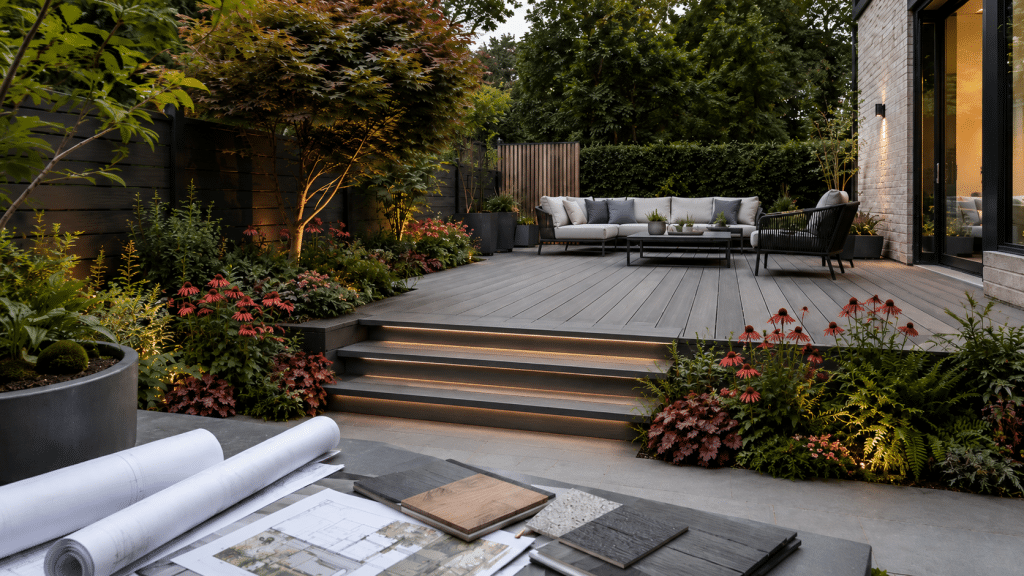
When designed properly, decking can create level access from the house. It can also deal with sloping ground, form seating areas, connect changes in level and turn awkward spaces into usable parts of the garden.
In addition, decking can work beautifully with lighting, balustrades, pergolas, outdoor kitchens, planters and covered structures. Once those elements come together, the deck becomes part of the architecture of the garden.
That is a long way from the old idea of decking as a cheap raised platform.
Why do garden designers avoid decking?
Some garden designers avoid decking because they have seen it done badly.
That is understandable.
Others avoid it because clients associate decking with maintenance, slipperiness, rot or cheap composite. Again, that concern has some history behind it.
However, some avoidance comes from outdated thinking. The decking market has changed. Materials have changed. Subframes have changed. Fixing systems have changed. Client expectations have changed. Yet, in many places, the conversation around decking has not changed quickly enough.
Today, a designer can consider modified timber, mineral-based decking, capped composite, aluminium subframes, HDPE subframes, hidden fixing systems, integrated lighting and carefully detailed balustrades.
Of course, those choices do not remove the need for skill. In fact, they demand more skill.
Even so, they give designers far more options than they had twenty years ago.
The issue is not decking. The issue is poor decking.
Bad decking usually follows a pattern.
First, the brief is vague. The client asks for “a deck”. Next, the contractor prices “a deck”. The designer may show a deck on a drawing, but without enough technical information. After that, the supplier sells the boards and the installer makes the frame fit the budget.
At that point, no one may have properly defined the structure, material, fixings, levels, drainage, edge protection, ventilation, maintenance, slip risk or expected lifespan.
That is where problems begin.
Decking needs the same seriousness as any other external construction. If it sits above ground, changes level, provides access, carries people, supports furniture or includes steps and exposed edges, then it needs proper thought.
For that reason, a deck should not arrive at the end of the design process as a surface choice. It should form part of the design strategy from the beginning.
Designers have an opportunity
Garden designers have a real opportunity here.
They do not need to become decking installers. Nor do they need to know every fixing, span table or product claim. However, they do need to understand when decking is appropriate, when it is not, and what information must be specified before a project reaches site.
That means asking better questions.
What is the deck for? How high is it? What load will it carry? How will water drain? What will support the frame? How will air move beneath it? Which material suits the setting? How will it age? What maintenance does it need? Does it require guarding? Will lighting be included? Could it affect privacy or planning? Is the client expecting a natural material, a low-maintenance product, or a perfect surface that does not exist?
Those questions change the quality of the project.
More importantly, they protect the designer, the contractor and the client.
Decking needs to be discussed in the open
For too long, the decking conversation has happened in fragments.
Installers talk to installers. Designers talk to designers. Suppliers talk to suppliers. Meanwhile, clients hear different things from different people.
As a result, confusion fills the gap.
That is one of the reasons we are holding Decking Day at Horticulture House on 3 July.
The point is not to promote decking blindly. Instead, the point is to discuss it properly.
We will look at materials, structure, lighting, planting, planning, Building Regulations, standards, safety, public realm, balustrades, handrails and client expectations. We will also bring some of the uncomfortable arguments into the open.
Because decking will not improve through silence.
It will improve through better specification, better installation, better products, better education and more honest discussion.
Good decking still has a place in garden design
Decking is not right for every garden. No material is.
Sometimes paving makes more sense. In other situations, gravel, clay pavers, setts, resin, concrete or planting will do the job better. Therefore, a good designer should never force decking into a design where it does not belong.
However, designers should not reject decking because of old assumptions either.
Good decking can solve real design problems. It can create beautiful spaces, reduce excavation, deal with level changes and bring warmth into a garden. It can also support outdoor living in ways that paving cannot always achieve.
So, the question is not whether designers should use decking more often.
The better question is whether designers should understand decking more clearly before they decide.
So, why do some garden designers still avoid decking?
Perhaps decking has disappointed them.
Perhaps the industry has failed to explain what good decking now looks like.
Or perhaps too much bad decking has damaged the reputation of good decking.
Whatever the reason, the conversation needs to change.
Decking is not dead.
Bad decking is dead.
The future belongs to properly designed, properly specified and properly built external structures.
That is the discussion we need to have at the 2026 Decking day on the 3rd of July at Horticulture House… more info here